


For when everyday stress feels louder than it used to.
The mood that's hard to name. Not anxious exactly. Not depressed. Just slightly less than yourself, more often than you'd like.
Most supplements treat stress like the whole problem. Safra Ease is built for the mood underneath it too.
Sound familiar?
- Snapping at something small and knowing it wasn't about that
- Going through the motions but not really feeling it
- Tired but too wired to actually rest
- Running on fumes and calling it fine
What shifts first.
- A lighter, more elevated baseline day to day
- You catch yourself before you react
- Clearer, more focused thinking during busy hours
- More of the time, more like yourself
Every ingredient for a reason.
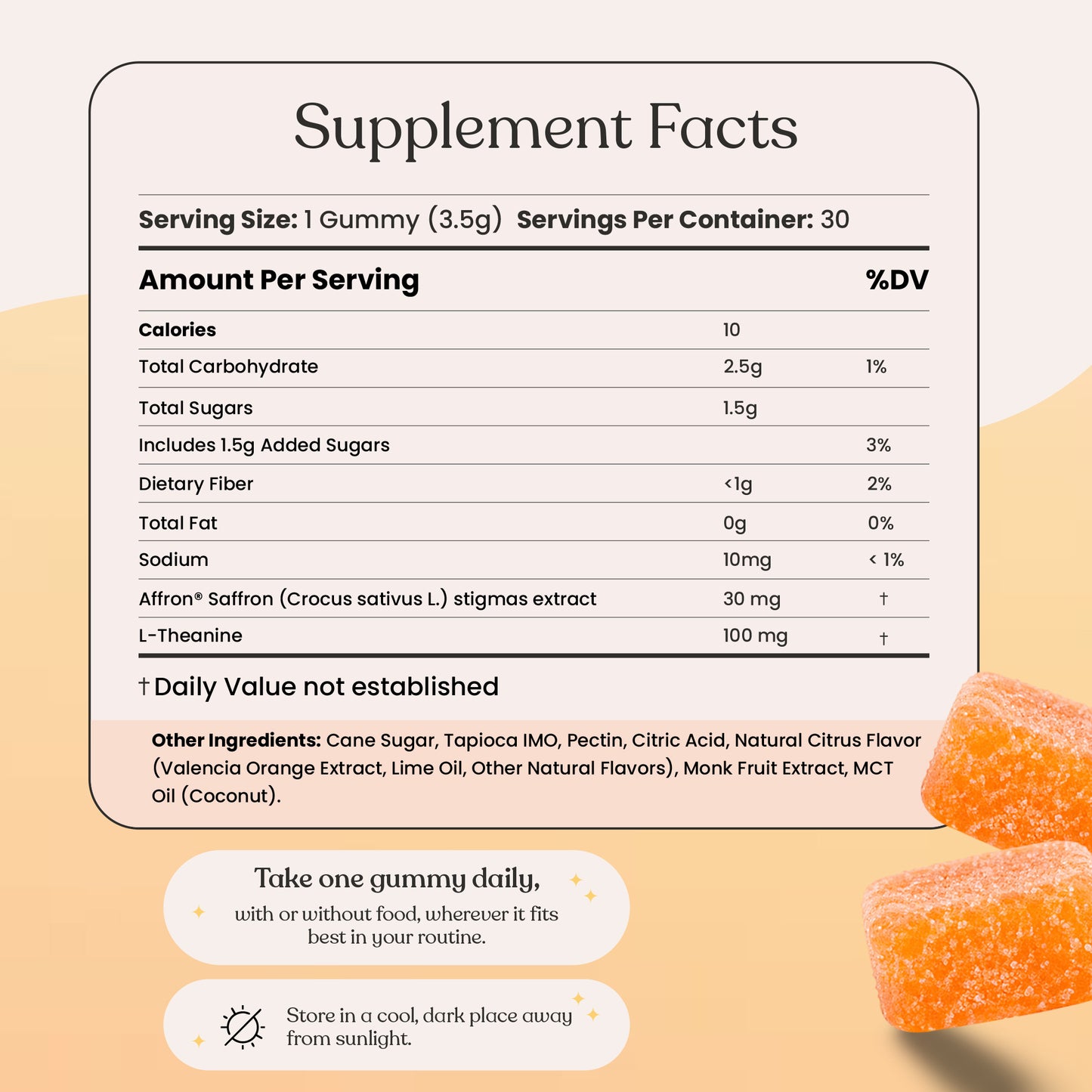
The clinically studied form of saffron, standardized to 3.5% lepticrosalides. Its unique compounds, crocin and safranal, help the brain use serotonin and dopamine more efficiently rather than forcing a surge. The result is a steadier mood, more motivation, and emotional balance that builds over time, without sedation and without the crash.
Found naturally in green tea, L-theanine shifts the brain into a calm-awake state by increasing alpha brain wave activity: the mental pattern associated with relaxed focus and reduced mental noise. It also supports GABA, the brain's natural calming chemical, smoothing out the physiological tension that makes stress feel louder than it should. Alert, present, and less reactive without the drowsiness.
One gummy. Anytime of day.
Ready to feel the difference?
Start your ritual →This is not a fast supplement. It's a consistent one.
-
Weeks 1–2The edge comes off.
L-theanine shifts the brain toward alpha wave activity within days, bringing calmer afternoons, less mental noise, and a steadier stress response. Saffron is beginning to build its effect on mood and dopamine pathways.
-
Weeks 3–6Something shifts.
The phase most people describe in hindsight. Saffron's support for serotonin and dopamine activity compounds, mood feels more stable and present, and the hard moments cost a little less. The research shows the most reported improvement in mood and emotional balance happening in this window.
-
Weeks 7–12The new baseline.
This is where it compounds. Saffron's protective effect on mood pathways deepens with consistent use, and the 12-week study showed continued improvement all the way through the final measurement.
The research behind it.
The key Affron® clinical study was a 12-week randomized double-blind placebo-controlled trial with 202 participants, taking 28mg of Affron® daily. 72% reported meaningful improvement in mood and emotional balance. The placebo group came in at 54%. Safra Ease uses 30mg, meeting and exceeding the studied dose. That's not a promising ingredient. That's a studied one.
Saw meaningful improvement in mood.
Most noticed a shift by week 5.
Not all saffron is created equal.
What most stress supplements do
- Chase one pathway, usually cortisol
- Use trendy ingredients without clear dosing or standardization
- Focus on "calm" without addressing underlying mood
- Reference research that doesn't match what's actually in the formula
- Feel inconsistent, or work only short-term
What Safra Ease does differently
- Works across serotonin, dopamine, and norepinephrine for a more complete shift in mood and resilience
- Uses Affron® at 30mg, above the clinical 28mg dose
- Supports both stress response and the emotional baseline underneath it
- Built around a 12-week, double-blind human study with 202 participants
- Designed for consistency, not spikes or quick fixes
Start the 12 weeks.
Start your ritual →What a shift actually feels like.
We don't lead with dramatic transformations, because that's not how saffron works and it's not how our customers describe it.


Take one gummy daily, with or without food, wherever it fits best.
Start the day with a steadier mood and sharper focus before the noise kicks in.
Take the edge off when the day starts asking more than it should.
Quiet the brain that won't stop so you can actually rest.
Questions, answered honestly.
No, and this is the question we hear most. Saffron's mechanism is recalibration and elevation, not suppression. The pathways it supports are the same ones tied to mood, motivation, presence, and follow-through. The research does not describe emotional blunting. It describes a more reliable, more elevated baseline. The goal is more access to yourself, not less.
Affron® is a patented extract standardized to a minimum of 3.5% lepticrosalides, the bioactive fraction that includes crocin and safranal. Most culinary saffron and many generic supplement forms are not standardized to this level. Standardization is what makes clinical results translatable: when a study reports an outcome at a specific dose of Affron®, those results are tied to a verified extract, not saffron as a general category.
That's the saffron. It's a botanically complex spice with a naturally earthy, floral character, the same quality that makes it one of the most studied ingredients in wellness. It's not a defect, it's a sign you're getting the real thing at a meaningful dose. Storing your bottle in a cool, dark place away from heat and sunlight helps keep the flavor at its best.
No, Safra Ease won't make you drowsy during the day. Neither Affron® nor L-theanine is a sedative. What they do is help quiet the mental noise and stress response that keeps a lot of people wired at night.
That said, saffron has actually been studied specifically for sleep. Multiple randomized controlled trials on Affron® found meaningful improvements in sleep quality, time to wind down, and how people felt when they woke up. One study used 28mg taken an hour before bed — the same dose Safra Ease meets and exceeds. The effect isn't sedation. It's that when your nervous system isn't running at full speed, sleep tends to follow more naturally.
Some people notice a shift in weeks one or two, mostly from the L-theanine. Most notice saffron's effect on mood and emotional balance around weeks three to six, often in retrospect. The full clinical study ran 12 weeks. We recommend giving it at least 30 days before evaluating, and if you don't feel a difference, we'll make it right.
Ashwagandha primarily works on the cortisol and HPA axis pathway, targeting stress response. It can be effective for certain kinds of stress, but it doesn't directly support the pathways most tied to mood and motivation. Saffron works across serotonin, dopamine, and norepinephrine: three pathways that govern how you feel, how motivated you are, and how present you can be. It addresses both stress and the emotional baseline underneath it. Saffron also carries no documented concern around hormonal disruption, which has become a noted issue for some people taking ashwagandha consistently.
No. There are no addictive compounds in Safra Ease and no withdrawal effects if you stop. Some people notice when they run out, not because of dependence, but because they feel the difference in their mood and baseline.
Saffron has actually been studied alongside antidepressants and shown to be well tolerated as a complementary addition. Clinical research suggests it can support mood through different pathways than most medications, which is why many people take it alongside their existing routine. That said, if you're on any prescription medication we always recommend a quick check with your healthcare provider before adding anything new, just as standard practice.
The easiest way to stay consistent.
The best rituals are the ones that show up without thinking. Subscribe and Safra Ease handles itself.